.png)
Tel: +86-13761027061

E-mail: contactus@audfly.com

.png)


.png)
Directional speakers deliver audio toward a specific listening area instead of distributing sound broadly throughout a space. By creating focused listening zones, they help reduce unwanted sound spill and allow audio content to be heard where it is most relevant. Common applications include retail stores, museums, exhibitions, transportation hubs, and interactive displays.
But how do directional speakers work? This guide explains the principles behind directional sound, how ultrasonic parametric speakers create focused audio, and the practical considerations involved in choosing and using directional speaker systems.
In This Guide
Directional sound refers to audio delivered toward a particular listening area rather than spread broadly across an entire space. By controlling how sound is projected, directional audio systems can create focused listening zones, allowing people in the target area to hear audio while reducing unwanted sound in surrounding areas.
Different technologies can produce directional sound. One approach uses ultrasonic parametric speakers, which employ modulated ultrasound to generate audible sound through nonlinear interactions in the air. Other directional speaker designs use different acoustic principles and configurations.
Directional sound is useful in environments where multiple audio sources need to operate nearby without creating excessive noise or interfering with one another. Applications include museums, retail stores, digital signage, libraries, exhibitions, transportation hubs, and self-service kiosks.
Directional speakers are designed to concentrate audio toward a defined listening area. Unlike conventional loudspeakers, which often distribute sound across a relatively broad area, directional speakers help control where audio is most audible.
One common type is the ultrasonic parametric speaker. It uses a high-frequency ultrasonic carrier modulated with an audio signal. As the ultrasonic waves travel through the air, nonlinear acoustic effects help generate audible sound along the propagation path.
The result is a more localized listening experience. A person within the intended listening area can hear the audio clearly, while people outside that area may hear it at a lower level. Actual performance depends on the speaker design, installation, room conditions, and listening position.
Directional speakers are used in commercial environments to deliver localized information, support interactive experiences, and reduce unwanted sound spill between nearby audio zones.
Traditional loudspeakers are suitable for filling a room or a large area with sound. However, when several audio sources operate close to one another, their sound can overlap and create acoustic clutter.
Directional sound systems focus audio on designated listening areas. This can help museums present different audio for individual exhibits, retailers deliver messages near specific displays, and interactive installations provide localized audio without broadcasting it throughout the entire space.
The operating principle depends on the type of directional speaker. This section focuses on ultrasonic parametric speakers, which use modulated ultrasound to create localized audible sound.
Conventional loudspeakers typically use a moving diaphragm to create sound. When an audio signal drives the speaker, the diaphragm vibrates and produces pressure waves in the surrounding air. These waves spread outward, although the distribution depends on factors such as frequency, speaker size, enclosure design, and the surrounding environment.
For many conventional speakers, sound spreads across a relatively broad listening area. This works well for general announcements, background music, and public address systems, but it can be less suitable when audio needs to remain localized.
Ultrasonic parametric speakers use ultrasound, which is sound at frequencies above the typical range of human hearing. The ultrasonic carrier is modulated with the desired audio signal and emitted by an array of ultrasonic transducers.
The relatively short wavelength of ultrasound, together with the transducer array and its design, helps the system produce a more directional sound beam. High frequency alone does not guarantee a narrow beam; the dimensions and configuration of the sound source also play important roles.
In an ultrasonic parametric speaker, the audio signal modulates the amplitude of a high-frequency carrier. As the modulated ultrasonic wave travels through the air, nonlinear acoustic effects generate audible frequency components from the signal.
This process allows audible sound to be produced along the ultrasonic beam's propagation path. The resulting sound can be more concentrated in a particular direction than sound from many conventional loudspeaker designs. The degree of directionality and the listening experience depend on the system and its operating environment.
Directional audio performance depends on more than the technology alone. Transducer arrangement, operating frequency, installation angle, distance from the listener, room reflections, and background noise can all influence the result.
For commercial applications, the speaker should be selected and positioned according to the target listening area and the audio content. Proper planning and testing help achieve suitable coverage and reduce unwanted sound in surrounding spaces.
Installing directional speakers usually involves selecting a suitable mounting position, aiming the speaker toward the intended listening area, and checking the resulting sound coverage. The specific requirements depend on the speaker model and application.
Placement is particularly important because the direction and coverage of the audio beam affect what listeners hear. Installers should consider the room layout, listening distance, mounting height, reflective surfaces, and the movement of people through the space.
The connection process depends on the product. Some systems use a straightforward audio input, while others may require additional components or configuration. Reviewing the product documentation before installation helps identify the necessary connections and mounting accessories.
Testing the system in its actual environment is also important. It helps verify that the intended audience can hear the content clearly and that sound spill into adjacent areas is appropriate for the application.
Different applications have different requirements for sound coverage, installation, and listening distance. Whether you are planning a museum, retail store, exhibition, digital signage installation, or another commercial project, Audfly can help you explore suitable directional speaker options.
Explore Audfly Directional Speakers
Directional sound technology helps deliver audio where it is needed instead of filling an entire space with sound. For commercial environments, this can provide several practical benefits:
The results depend on the selected technology, the application, and the installation environment. Directional speakers are most useful when localized audio delivery addresses a specific sound management challenge.
Directional speakers are used in a range of environments where audio needs to be delivered to a particular area. The following examples illustrate how localized sound can support different applications.
In retail environments, directional speakers can deliver product information, promotional messages, or audio content near selected displays. This allows shoppers to hear relevant information without requiring the same content to be broadcast throughout the store.
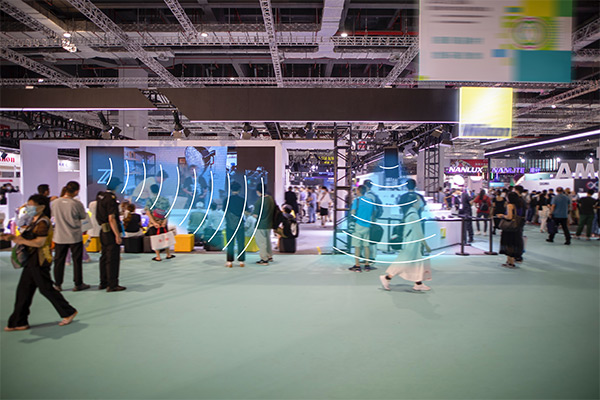
Museums and exhibitions can use directional audio to provide narration or supplementary information near individual exhibits. Different listening zones can help visitors explore displays at their own pace while reducing interference between nearby audio sources.
In suitable settings such as transport hubs and shopping centres, directional speakers can deliver announcements toward a designated area. System design and placement should account for ambient noise, coverage requirements, and the need for messages to remain intelligible.
Directional audio may be used to create more localized listening areas for television, entertainment, or interactive experiences. Actual isolation between listening areas depends on the speaker design, room acoustics, and listening positions.
In meeting and communication environments, directional speakers can help deliver audio toward a particular listening position or zone. They should not be assumed to provide complete speech confidentiality, since sound may still be audible outside the intended area.
The performance of a directional speaker depends on choosing the right equipment and using it appropriately. The following considerations can help improve results in real-world installations.
Position the speaker so that its intended listening area aligns with the target audience. Consider mounting height, angle, distance, room layout, reflective surfaces, and how people move through the space.
Set the volume to provide clear audio within the target area without creating unnecessary sound levels. Follow the product's recommended settings and test the result in the actual environment.
Match the audio content to the application. Retail displays may use short promotional messages, while museum installations may provide narration or additional exhibit information. Clear, relevant content helps listeners understand the message quickly.
Check speaker positioning, connections, and audio performance periodically. Testing after installation or when the surrounding layout changes helps maintain appropriate sound coverage.
Choosing a suitable directional speaker starts with understanding the application. Important factors include the size of the listening area, required audio coverage, installation position, audio source, and the environment in which the system will operate.
Audfly offers directional audio solutions for a range of commercial applications. Explore the product range to compare available options, or contact the team to discuss the requirements of your project.
Explore Audfly Directional Speakers
Directional sound is audio delivered toward a particular listening area rather than spread broadly throughout a space. It can help create localized audio zones and reduce unwanted sound spill.
The operating principle depends on the speaker design. Ultrasonic parametric speakers use a modulated ultrasonic carrier and nonlinear acoustic effects in the air to generate audible sound. Other directional speaker systems may use different technologies.
Common applications include museums, retail stores, exhibitions, digital signage, libraries, transportation hubs, interactive kiosks, and other environments where localized audio can be useful.
Conventional speakers are often designed to distribute sound across a broad area, while directional speakers focus audio toward a designated listening zone. The degree of directionality varies by technology and installation.
Some commercial directional speaker systems can be customized for factors such as dimensions, mounting method, appearance, accessories, or OEM branding. Available options depend on the product and project requirements.
From ultrasonic directional speakers to solutions for outdoor audio applications, Audfly offers products for different commercial environments. Contact the team to discuss your application and explore suitable options.


.png)
.png)






.png)

.png)
.png)


.png)


.png)