.png)
Tel: +86-13761027061

E-mail: contactus@audfly.com

.png)


.png)
There are different ways to protect conversations from unauthorized recording. Some solutions use audible sounds, such as white noise, to make recorded speech harder to understand. Others take a different approach by using ultrasonic technology.
So, how does an ultrasonic audio jammer work? And what makes it different from traditional white noise solutions?
An ultrasonic audio jammer uses ultrasonic technology to help protect conversations from unauthorized recording. Unlike traditional noise-based solutions, its protective effect is created directly within the acoustic environment.
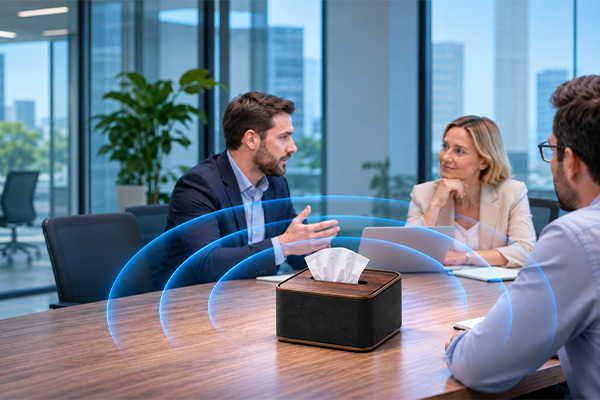
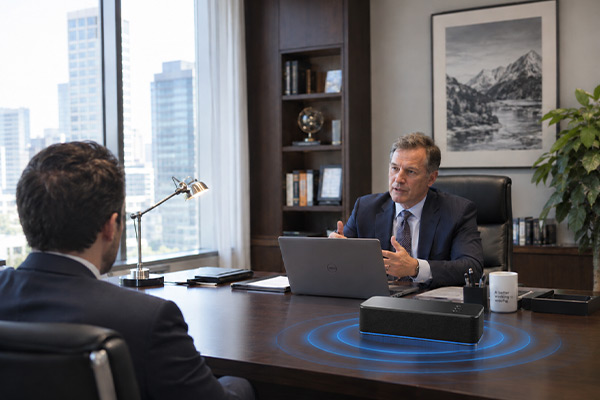
Audfly SonicShield is a typical example of an ultrasonic audio jammer. It creates an active acoustic protection layer around a conversation and uses ultrasonic technology to interfere with microphone capture while people are speaking, making the recorded speech more difficult to understand and transcribe.
During operation, SonicShield does not need to detect, connect to, or control recording devices. It relies entirely on acoustic technology to create an active layer of protection around the conversation, without disrupting normal face-to-face communication.
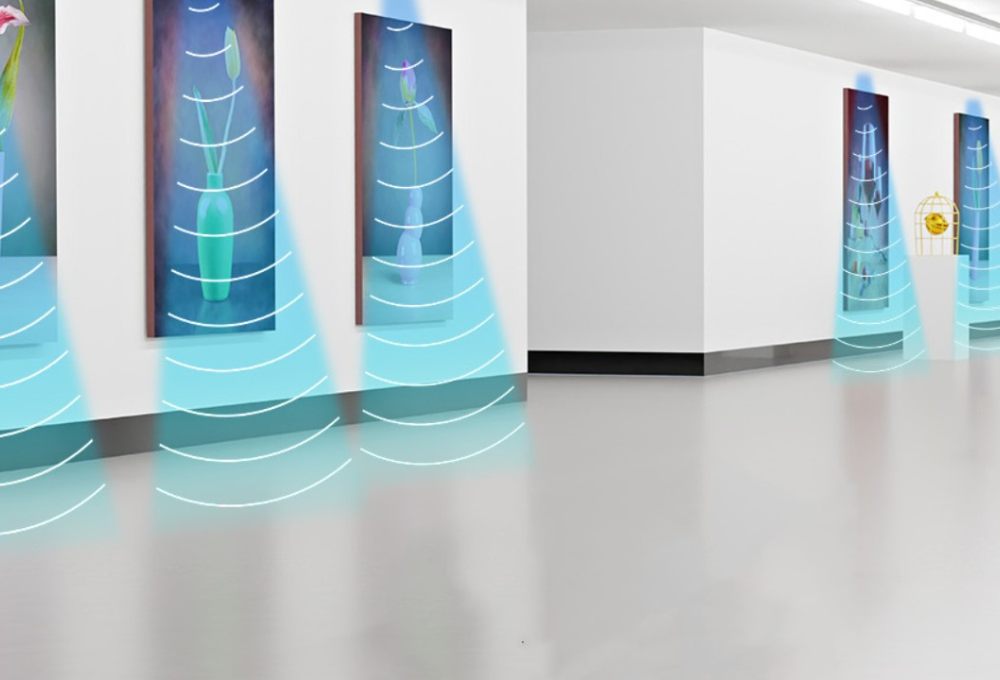
Ultrasonic audio jammers work by emitting controlled ultrasonic signals above the normal human hearing range.
When these signals are received by some MEMS microphones, nonlinear characteristics in the microphones and their associated electronic circuits may generate intermodulation effects. This can introduce interference into the recorded speech-frequency range.
As a result, the signal-to-noise ratio of the captured audio may be reduced, making recorded conversations more difficult to understand and transcribe.
The effectiveness depends on factors such as the recording device, distance, orientation, room acoustics, and system configuration.
Although both approaches can help reduce the intelligibility of recorded conversations, their working principles are quite different.
| Comparison | Ultrasonic Audio Jamming | White Noise Masking |
|---|---|---|
| Working principle | Uses controlled ultrasonic signals to interfere | Uses audible noise to mask speech |
| Frequency range | Above the normal human hearing range | Within the audible frequency range |
| Audible experience | Inaudible to the human ear | Typically perceived as background noise |
| Impact on conversations | No impact on normal conversations | Background noise may make conversations less comfortable |
The main difference is simple: white noise uses audible sound to mask conversations, which can provide a certain level of protection but may also interfere with the conversation. Ultrasonic audio jamming, on the other hand, uses ultrasonic technology to protect conversations without disrupting normal communication.
Audfly SonicShield applies ultrasonic technology to active acoustic protection, helping reduce the intelligibility of speech captured by certain unauthorized recording devices.
By introducing controlled ultrasonic interference into the recording process, SonicShield provides an alternative to conventional audible noise-based protection.
Whether in an office, a meeting space, a coffee shop, or another shared environment, SonicShield offers an additional approach to protecting everyday conversations.
Looking for a way to protect conversations from unauthorized recording?
If you are looking for an acoustic protection solution for your space, explore Audfly SonicShield to learn more about its technology and applications, or contact our team to discuss your requirements.
Actual protection performance depends on factors such as the recording device, distance, orientation, room acoustics, and system configuration.


.png)
.png)





.png)
.png)
.png)


.png)


.png)