.png)
Tel: +86-13761027061

E-mail: contactus@audfly.com

.png)


.png)
A sound beam speaker is a type of directional audio device designed to deliver sound to a precisely defined listening area, rather than spreading audio evenly in all directions like a traditional speaker. This allows only people located within the targeted zone to hear the sound clearly, while those outside the beam experience little or no audible audio.
Unlike conventional loudspeakers that rely on broad sound dispersion, sound beam speakers use directional audio technology to control where sound travels in space. The result is a highly focused audio experience that improves clarity, reduces ambient noise, and enables audio content to coexist in close proximity without interference.
Because of this controlled sound delivery, sound beam speakers are commonly used in professional and commercial environments—such as museums, exhibitions, retail spaces, and public information systems—where audio precision and listener-specific communication are essential.
A sound beam speaker works by using directional audio technology to control the path of sound waves, ensuring that audio is delivered only to a specific location. Instead of allowing sound to spread naturally in all directions, the speaker actively shapes and steers the sound into a focused beam.
This is why a sound beam speaker can deliver clear audio to a listener standing in a specific position, while people just a short distance away hear little or nothing. The sound is not made louder—it is made more controlled.
The fundamental difference between a sound beam speaker and a traditional speaker lies in how sound is distributed in space.
Traditional speakers emit sound broadly, allowing it to disperse throughout a space so that people in the area can hear the audio, though the distribution is not perfectly uniform and the sound intensity decreases with distance. While this approach works well in enclosed or controlled environments, it often creates challenges in open or shared spaces—such as noise spill, overlapping audio, and reduced clarity.
Sound beam speakers, by contrast, are designed for precision rather than coverage. They focus sound into a narrow, controlled beam, ensuring that audio reaches only the intended listener or zone.
| Aspect | Sound Beam Speaker | Traditional Speaker |
|---|---|---|
| Sound Direction | Highly focused, directional beam | Wide, omnidirectional spread |
| Audio Privacy | High | Low |
| Noise Spill | Minimal | Significant |
| Use in Open Spaces | Highly effective | Often problematic |
| Typical Applications | Museums, retail, exhibitions, public displays | Homes, auditoriums, background music |
Because of these differences, sound beam speakers are especially valuable in environments where multiple audio messages must coexist or where maintaining a quiet, controlled atmosphere is important.
The primary advantage of a sound beam speaker lies in its ability to deliver audio in a highly controlled and Public areas, without increasing overall ambient noise. This makes it fundamentally different from traditional speakers that rely on wide sound dispersion.
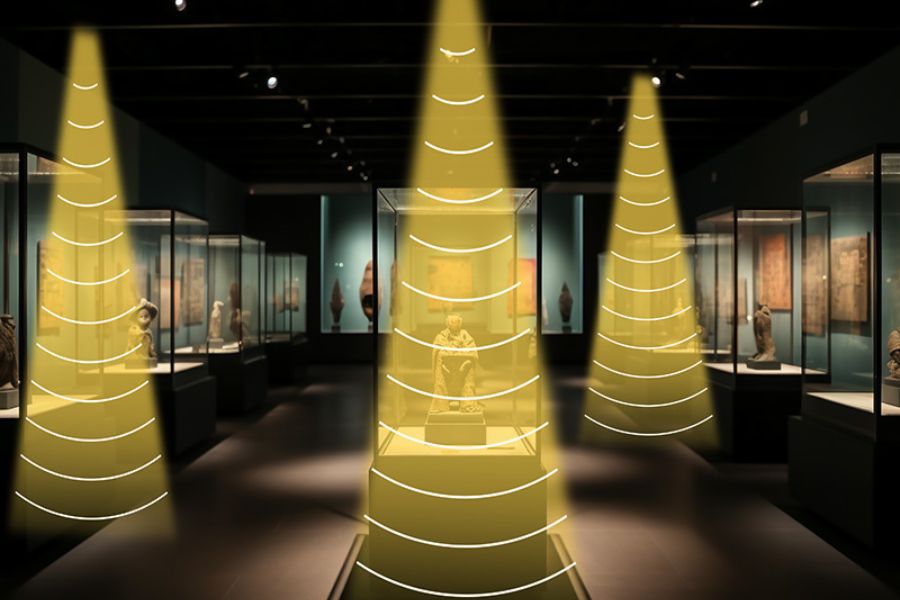
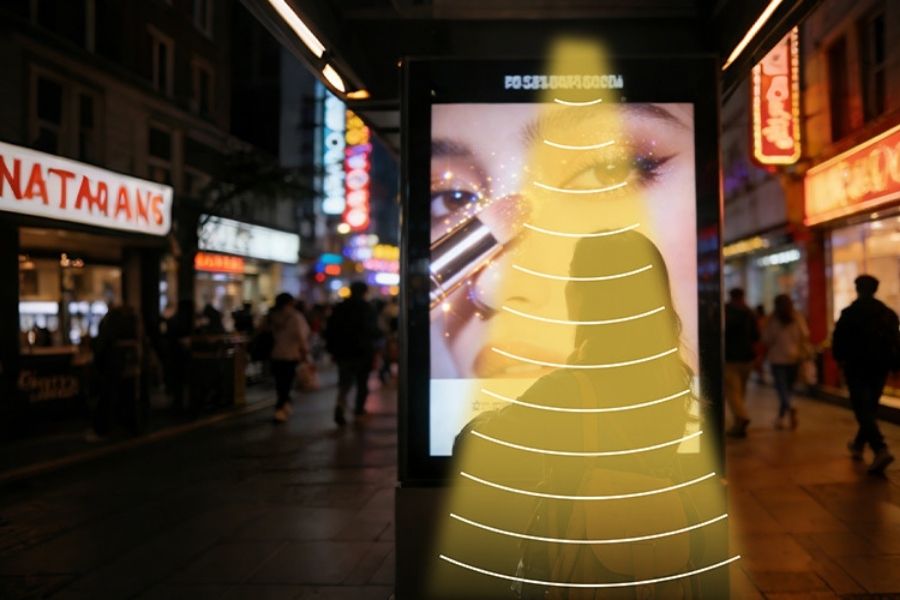
Sound beam speakers generate audio in a fixed shape and direction, similar to a flashlight beam. Clear sound is delivered only within the target area, while areas outside the beam receive little or no audible sound.
Because sound is not broadcast broadly, sound beam speakers do not raise background noise levels in nearby spaces. This is especially important in environments where quiet surroundings must be maintained.
Directional sound allows speech content to remain intelligible even in noisy environments. By concentrating sound energy within a defined area, listeners experience clearer audio without the need for higher volume levels.
Unlike traditional speakers that struggle with sound leakage in open or shared environments, sound beam speakers enable precise sound placement without requiring physical barriers or enclosed spaces.
These benefits make sound beam speakers particularly suitable for public spaces where precise audio delivery is needed without interfering with surrounding areas.
Sound beam speakers are ideal for public areas where precise audio delivery is essential. They are commonly used in museums and galleries, libraries, retail spaces, digital signage, luxury stores, hospitals and nursing homes, conference rooms, and exhibition booths. By focusing sound directly on the intended listener, these speakers provide clear, intelligible audio without disturbing surrounding areas, making them perfect for professional spaces that require both privacy and acoustic control.
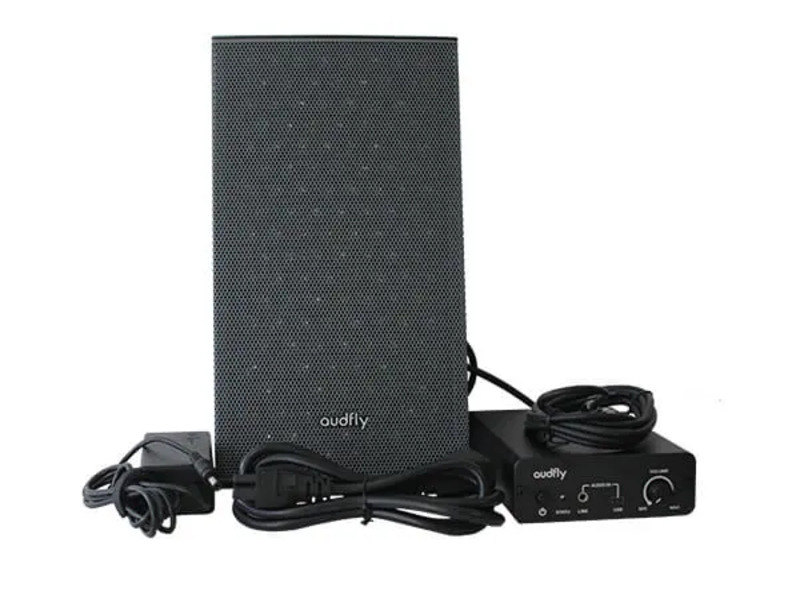
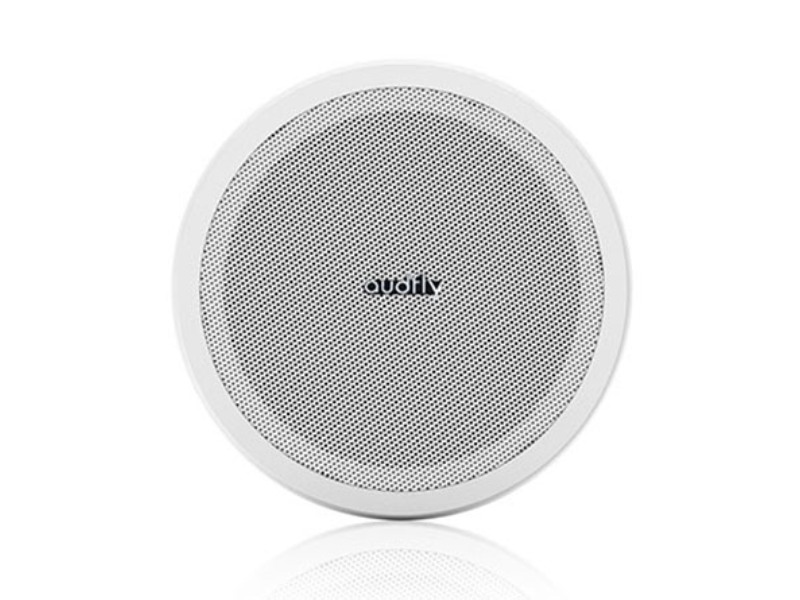
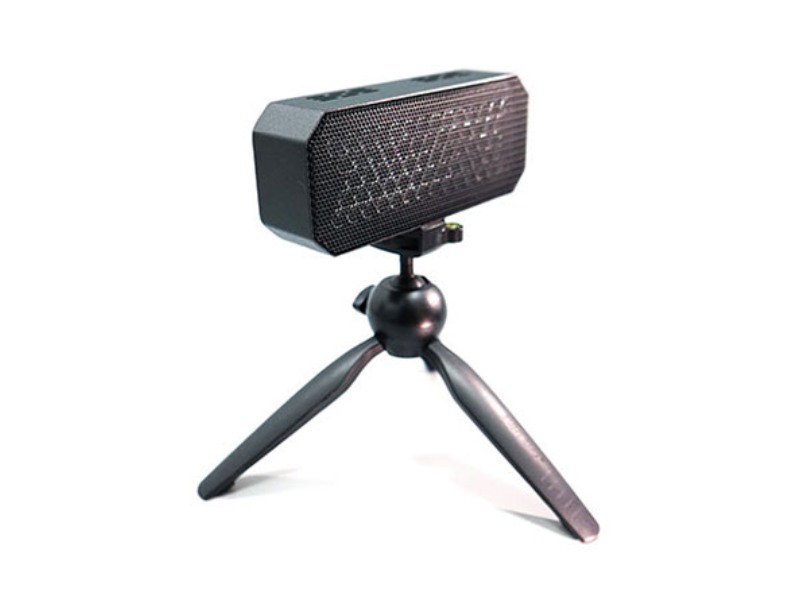
Companies like Audfly offer solutions that deliver highly focused directional audio, tailored to the needs of public spaces. These systems ensure sound reaches the intended area with precision, provides clear speech, and minimizes unwanted noise in surrounding areas. By strategically designing and deploying directional audio, Audfly enables institutions and businesses to create immersive, controlled sound experiences without relying on traditional loudspeakers.
It is important to distinguish a sound beam speaker from consumer products such as soundbars or home theater systems like the Sonos Beam. While soundbars are designed to enhance audio for televisions in home environments, sound beam speakers are engineered for professional directional audio applications.
Audfly directional speakers generate audio in a precisely fixed shape and direction, similar to the beam of a flashlight. Sound can only be clearly heard within the target area, and the surrounding environment remains virtually unaffected. This contrasts sharply with traditional speakers, including soundbars, which rely on electromagnetic induction to produce sound that propagates broadly and cannot maintain such tight directional control.
By using the ultrasonic parametric principle, Audfly sound beam speakers achieve highly focused audio with minimal dispersion, maintaining clarity and privacy even in indoor spaces with multiple overlapping activities. This makes them uniquely suited for professional and commercial environments, such as museums, retail spaces, luxury stores, and healthcare facilities, where precise sound placement and minimal ambient noise are critical.
A sound beam speaker is a highly specialized directional audio solution that delivers sound with precision and control, ensuring that audio is clearly heard only within a targeted area while minimizing ambient noise in surrounding spaces. Unlike traditional speakers or consumer soundbars, sound beam speakers—such as those developed by Audfly—use ultrasonic parametric technology to create a narrow, focused beam of sound, providing high speech clarity and acoustic privacy even in complex indoor environments.
This technology is particularly valuable in public areas where precise audio placement, minimal interference, and controlled soundscapes are essential. From museums and galleries to retail spaces, luxury stores, hospitals, and exhibition booths, sound beam speakers enable immersive and effective communication without disrupting the surrounding environment.
By integrating directional audio systems thoughtfully, institutions and businesses can create tailored auditory experiences that deliver both clarity and control, demonstrating why sound beam speakers have become an indispensable tool for modern professional audio applications.


.png)
.png)





.png)
.png)
.png)


.png)


.png)